


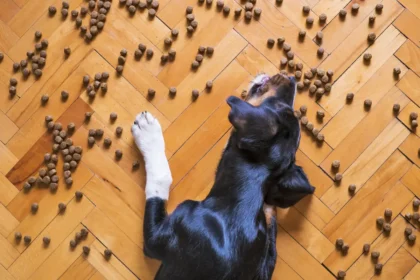
 Dry food is an industrial product of the post-war era: cheap to make, long-lasting and sold with a good margin. During production it is heated strongly, which destroys nutrients that are then replaced with artificial vitamins and minerals. It contains hardly any water, and the idea that it cleans teeth is a myth. Here you can find out what lies behind the kibble and what to look out for.
How did dry food come about?
Before the Second World War, canned dog food was common. During the war it was rationed. In the 1950s, a large US manufacturer then adopted extrusion from the production of breakfast cereals for its dog food. This is how the kibble we know today came about.
For manufacturers and retailers, dry food has clear advantages: the ingredients are cheap, a bag keeps for a long time, is easy to store and hardly smells. It is convenient above all for people. Whether it is also the best diet for the dog is another question.
What happens during production?
In extrusion, a dough of meat meal, cereals or other sources of starch, fat and additives is pressed through a nozzle under high pressure and at high temperature. It is then dried. Sensitive nutrients are lost in the process. A 2024 study measured this for vitamin A: after the first heating step around 26 % was already gone, and after extrusion and drying 34 % in total.
That is why manufacturers often spray vitamins onto the kibble only after extrusion. One patent mentions vitamin losses of 30 to 40 % in the extruder. Much of what ends up in the food has therefore been added afterwards: artificial vitamins and minerals meant to replace what was lost during heating.
Nothing in dry food is fresh; it is like a frozen pizza. Imagine eating nothing but frozen pizza for a year and taking multivitamin tablets with it: you would be full, but hardly well nourished.
“Cold-pressed” does not mean without heat either. The term only refers to pressing the pellets. Friction and pressure still create heat, and the ingredients have usually been dried beforehand.
How much meat is really in dry food?
The information on the pack is often hard for non-experts to understand, and a high meat content is often misleading. If a dry food advertises 80 % fresh meat, for example, the figure refers to the weight before drying. Fresh meat consists largely of water, and that is no longer in the finished food. Calculated on dry matter, the meat content therefore looks very different.
Did you know that a pack may already say “with beef” if it contains only 4 % beef? Only “rich in beef” requires 14 %, and a “beef menu” 26 %. Yet your dog is around 70 % carnivore.
The rest often consists of carbohydrates used as fillers: cereals, maize, white rice or broken rice. They consist mainly of starch, that is, of complex sugars. They bulk up the food, make it heavier and create a feeling of fullness, just like the sugary beet pulp that is often used.
How to read the declaration
- Closed declaration: Ingredients are only named in groups, such as “meat and animal derivatives” or “cereals”, without percentages. You do not find out what exactly is behind them.
- Semi-open declaration: Some ingredients are given with percentages, for example “meat and animal derivatives (including 4 % beef)”. The rest remains open.
- Open declaration: All ingredients are listed with percentages, adding up to 100 %. This is what a meaningful meat declaration looks like: “lamb 92 %, of which lamb muscle meat 70 %, lamb lung 14 %, lamb liver 8 %”.
- Order: Ingredients are listed in descending order of quantity. If cereals come first, there are more cereals than anything else.
- Animal derivatives: If they are not specified in more detail, they can also include slaughter waste.
- Analytical constituents: Crude protein, crude fat and crude ash say little about quality. Where the protein comes from is not stated there.
- Not everything is on the label: Many additives do not have to be declared if they are already contained in the raw materials. Attractants and flavourings are also often sprayed on afterwards.
Why does your dog lack water with dry food?
Dry food contains only around 10 % moisture. Wet food has 70 to 85 %, and fresh food is similarly high. A dog eating dry food therefore takes in hardly any water with its food. Dry food draws water from the body, which your dog has to make up for at the water bowl.
So make sure fresh water is always available, and watch how much your dog really drinks.
What does dry food do to digestion?
Researchers at the University of Illinois compared different types of food: fresh, gently cooked food was more digestible for the dogs than extruded dry food, and the dogs produced less faeces.
In our experience, dry food also stays in the gut for a long time. We consider it possible that this long transit time puts a strain on the gut flora. So far, however, there are only a few small studies on this.
Does dry food clean the teeth?
No. The idea that dry food cleans teeth is a myth and pure marketing. Many dogs swallow the small kibble almost whole without chewing it. Where nothing is chewed, nothing is rubbed off.
Regular tooth brushing, suitable chews, regular checks of the mouth and special complementary feeds help keep teeth clean. If there is heavy, hard, already mineralised tartar or inflamed gums, your dog needs to see the vet.
Mould toxins in dry food
Dry food can contain mould toxins such as aflatoxins and ochratoxin, especially food containing cereals and goods stored open. In a study from Turkey with 90 samples, the researchers saw a considerable risk. In a study from Mexico, all samples tested were contaminated, and 11.8 % were above the limit.
If you feed dry food, store it dry, cool and tightly closed, and preferably buy smaller packs that are used up quickly.
Do dogs on fresh food live longer?
Two Belgian vets, Gerard Lippert and Bruno Sapy, analysed data from more than 500 deceased dogs in 2003. They found that dogs on freshly prepared food lived to an average of 13.1 years, dogs on industrial food to 10.4 years. That is a difference of around 32 months.
What you can do
- Feed fresh: Freshly prepared food contains plenty of moisture and is gently processed. You can read how to get started with fresh food in our article on BARF.
- Switch slowly: Replace the old food with the new one step by step over at least a week. A light, easily digestible variety such as chicken is a good start. Softer stools in the first few days are normal when switching from dry to wet food and will settle.
- Keep an eye on water: Always offer fresh water, especially if your dog is (still) getting dry food.
- Store properly: Keep dry food dry, cool and closed, and use up opened bags quickly.
- Care for teeth: Tooth brushing and suitable chewing material such as raw meaty bones (never cooked), rabbit ears with fur or air-dried meat strips instead of relying on kibble.
- Ask the vet: If your dog has an illness or needs a special diet, discuss the switch with the vet practice first.
Frequently asked questions
Is dry food bad for dogs?
Dry food is highly processed: nutrients are lost during heating and are replaced artificially, and it contains hardly any water. Fresh food is processed more gently and contains moisture.
Does dry food help against tartar?
No. The idea that dry food cleans teeth is a myth. Many dogs swallow the kibble almost whole. Tooth brushing, suitable chews and the vet help against tartar.
Why does my dog drink so much with dry food?
Dry food contains only around 10 % moisture. What is missing from the food your dog has to drink, but very few dogs drink enough to make up for it. If your dog drinks conspicuously much, however, have it checked by the vet anyway.
How do I store dry food properly?
Dry, cool and tightly closed, ideally in its original packaging inside an airtight container. Smaller packs are used up more quickly.
Sources
- Galli G. M. et al.: Stability of vitamin A at critical points in pet-feed manufacturing and during premix storage, Frontiers in Veterinary Science 2024 (English).
- Patent US 9585412: Vitamin losses during extrusion and coating afterwards (English).
- University of Illinois (EurekAlert!): Digestibility of fresh and extruded dog food (English).
- Mustafa Kemal University: Aflatoxins and ochratoxin A in dry dog food (Turkey, English).
- INIFAP, Revista Mexicana de Ciencias Pecuarias: Mycotoxins in dry dog food (Mexico, Spanish).
- Petfood Industry: Learn from the past, on the history of dry food (English).
- Lippert G., Sapy B.: Relation between the domestic dogs’ well-being and life expectancy, statistical analysis, Belgium 2003 (not published in a peer-reviewed journal, not available online).
- FEDIAF: Code of Good Labelling Practice for Pet Food (labelling of “with”, “rich in”, “menu”; English).
Dry food is convenient, but convenient is not the same as good. The fresher and less processed your dog’s food is, the less has to be replaced artificially in the end.
Read more: BARF for beginners · Fresh food: good for your dog
The content of the articles is for general information purposes only and does not replace diagnosis or treatment by a veterinarian. Reviews or testimonials are individual reports from verified customers. This information does not constitute medical advice and should not be understood as such.
Our daily inspiration comes from the special moments with our dogs. Here we share this enthusiasm and invite you to become part of the DOG FIT community on our social media channels.


Leave a Reply